
*Jacob Rabinovich
I. Introduction
In late 2024, in the aftermath of Hurricanes Helene and Milton, approximately 1,200 price gouging complaints were filed across four states.[1] Victims of natural disasters claim business owners and corporation excessively raised the prices of commodities and services like gasoline, groceries, hotels, and repair services.[2] Determining whether consumers face increased prices due to greed-fueled price gouging is complicated.[3] While increased prices are an economic reality of natural disasters because they increase the cost of supplies, create labor shortages, and disrupt supply chains, greed may also be a driving factor in price increases.
Since the COVID-19 pandemic, consumers have claimed that corporations mark up prices while blaming rising inflation to mask the higher prices.[4] Economists debate whether the increased prices are a product of ordinary economic factors or whether price gouging drives inflation.[5] Although many economists believe corporations do not engage in price gouging, the public perceives gouging and corporate greed as significant contributors to higher prices.[6] Public perception of corporate impact on inflation and high grocery prices shape the economic discussion on policy remedies.[7] Former Vice President Kamala Harris integrated a federal price gouging statute into the foundation of her presidential platform.[8] Her proposed legislation drew on successful current state statutes, addressing price gouging during states of emergency often brought about by natural disasters. [9]
II. Federal anti-hoarding law offers insufficient protection from alleged price gouging but provides a solid foundation
Although there is no federal prohibition on price gouging, an anti-hoarding provision within the Defense Production Act (DPA) has been used against individuals for charging unreasonable prices for scarce items during the COVID-19 pandemic.[10] The DPA provision forbids accumulating material designated as scarce “(1) in excess of the reasonable demands of business, personal, or home consumption, or (2) for the purpose of resale at prices in excess of prevailing market prices.”[11] After “st[anding] up to court scrutiny,”[12] the application of the anti-hoarding provision resulted in several convictions.[13]
The success of the anti-hoarding provision of the DPA offers good tidings for a potential federal price gouging ban that is well-defined and aligns with current state laws. Unlike the anti-hoarding provision, a broad federal price gouging statute would not be restricted to the confines of designated scarce resources and would instead focus on predatory behaviors during times of crisis.[14] Therefore, a federal price gouging statute would likely enable more robust consumer protections.[15] A federal price gouging statute would enable the federal government to charge alleged price gougers for exorbitantly increasing their prices, which would likely be effective at protecting consumers at a national level and establish graver, federal consequences for state offenders.[16]
III. State laws demonstrate that price gouging legislation is effective
Currently, at least thirty-seven states prohibit price gouging during emergencies[17] and many have successfully secured restitution for their citizens.[18] For instance, Texas law made it unlawful to set exorbitant or excessive prices for necessities—like drinking water, food, and gasoline—during a Governor-declared disaster.[19] After Hurricane Harvey and other crises in 2017, the Attorneys General of Texas and North Carolina brought price gouging lawsuits.[20] Texas’s Attorney General, Ken Paxton, enforced the statute against gas stations, some charging up to $9.99 per gallon, and secured settlements with at least sixty gas stations for over $300,000 and Assurances of Voluntary Compliance with four Dallas-Fort Worth Metroplex gas stations.[21]
North Carolina’s price gouging law has also been highly successful in providing restitution to the victims during crises. The North Carolina statute not only prohibits consumer-facing businesses from knowingly and intentionally “charg[ing] a price that is unreasonably excessive” during states of emergency, but also holds “all parties in the chain of distribution” liable for price gouging.[22] Between 2018 and 2022, the Attorney General’s Office secured over $1 million in judgments and settlements.[23] For instance, the Attorney General secured three settlements totaling over $80,000 against repair service companies for inaccurate representations of policies and pricing, as well as a gas station for raising prices by 60% without a correlating supply-side explanation.[24] Although North Carolina’s statute is primarily enforced against local, consumer-facing businesses, the statute’s provision to attach liability to upstream suppliers in the supply chain may provide an effective framework for a federal statute because it would enable the federal government to hold all alleged price gougers accountable.
State laws have different definitions of price gouging.[25] Consequently, businesses operating in multiple states must navigate diverging regulations to ensure that they do not violate current price gouging laws.[26] Establishing a federal definition of price gouging would create a more navigable regulatory scheme.[27] Although drafting an acceptable definition at a federal level likely entails challenges, the state laws and their effectiveness offer a roadmap,[28] and a federal price gouging statute based on state analogs may extend similar consumer protections to the states lacking any protections.
IV. Conclusion
Although a federal price gouging ban would face significant challenges if brought to Congress,[29] current state laws provide a foundation for drafting effective federal price gouging legislation.[30] Moreover, the federal anti-hoarding provision of the DPA demonstrates that enforcement is feasible.[31] Furthermore, a changing global economic landscape may also necessitate the need for a federal price gouging statute.[32] Even if price gouging is not occurring in the manner that the public or some politicians claim, there exists a tangible feeling of disdain towards corporations and the federal government for not working to prevent price gouging.[33]
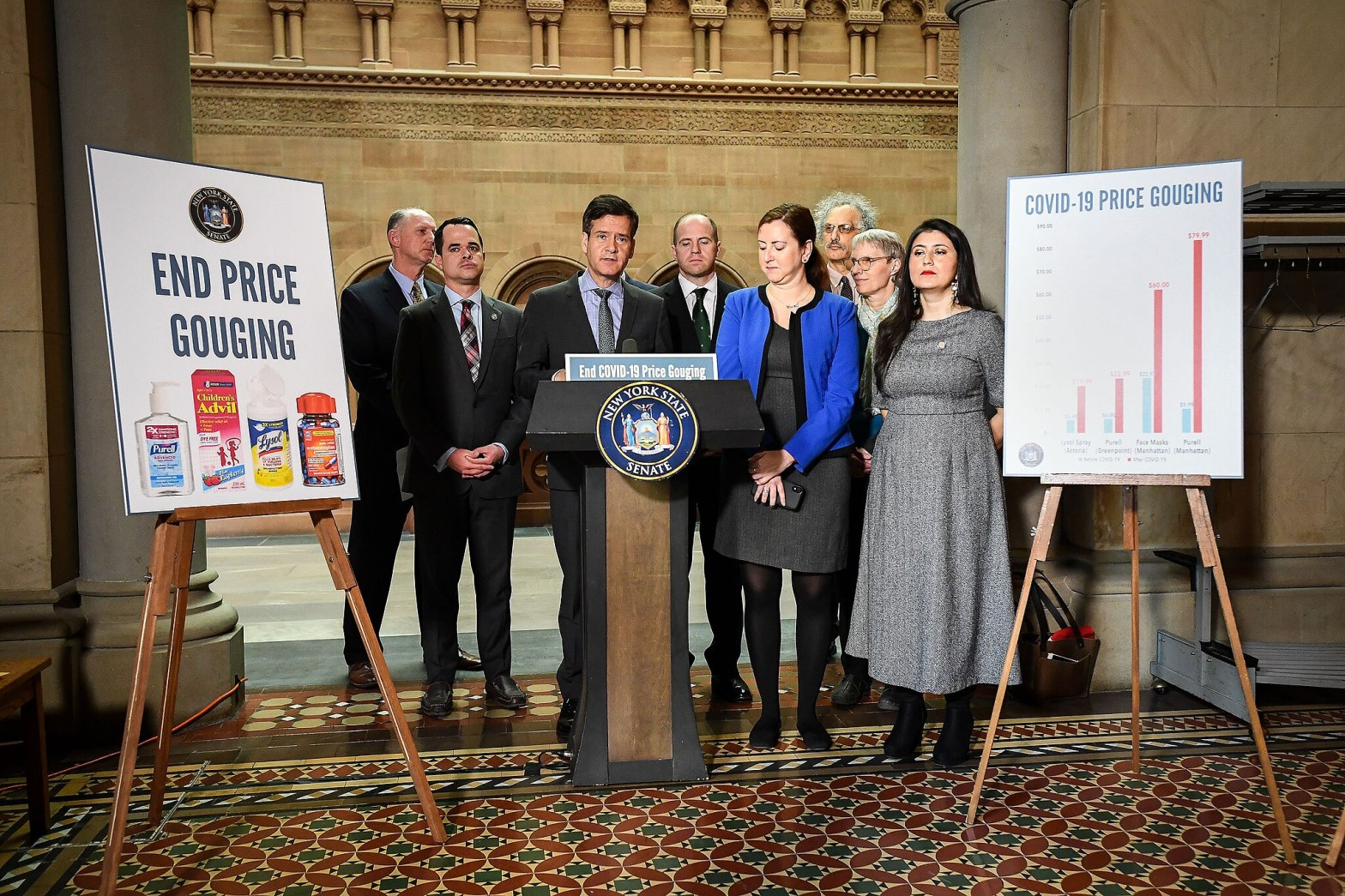
Photo Credit: New York Senate Photo, CC BY 2.0 https://creativecommons.org/licenses/by/2.0, via Wikimedia Commons
*Jacob Rabinovich is a second-year student at the University of Baltimore School of Law, where he is a Staff Editor for Volume 54 of Law Review, a Legal Writing Fellow, a Distinguished Scholar of the Royal Graham Shannonhouse III Honor Society, and an Invitee for the Byron Warnken Moot Court Competition. Last summer, Jacob served as a law clerk at the Law Office of Posner & Cord where he has continued his service as an extern in the fall semester. In May of 2025, Jacob is excited to join Davis, Agnor, Rapaport & Skalny as a Summer Associate.
[1] See Paul Blest, Helene and Milton Show the Reality of Disaster Price Gouging, Substack: More Perfect Union (Oct. 11, 2024), https://substack.perfectunion.us/p/helene-and-milton-show-the-reality.
[2] See id.
[3] See, e.g., Ricardo Marto, Structural Change and the Rise in Markups (Fed. Rsrv. Bank of St. Louis, Working Paper No. 2024-002, 2023), https://doi.org/10.20955/wp.2024.002.
[4] See Alina Selyukh, Are Greedy Companies to Blame for Grocery Inflation? We Looked at the Data, NPR (Sept. 9, 2024, 5:01 AM), https://www.npr.org/2024/09/09/nx-s1-5103935/grocery-prices-inflation-corporate-greedflation.
[5] See id.; see also Talmon Joseph Smith & Joe Renninson, Companies Push Prices Higher, Protecting Profits but Adding to Inflation, N.Y. Times (May 31, 2023), https://www.nytimes.com/2023/05/30/business/economy/inflation-companies-profits-higher-prices.html.
[6] See Deena Shanker, Enda Curran, & Jennifer Epstein, Kamala Harris’ Much-Hyped Price Gouging Ban Set to Disappoint Shoppers, Bloomberg (Oct. 16, 2024, 6:30 AM), https://www.bloomberg.com/news/articles/2024-10-16/kamala-harris-price-gouging-plan-could-underwhelm-inflation-hit-shoppers.
[7] See Aaron Brown, The Misuse of Data Behind the ‘Greedflation’ Narrative, Reason, (Oct. 29, 2024, 1:15 PM), https://reason.com/video/2024/10/29/greedflation-misuse-data/.
[8] See Kamala Harris & Tim Walz, A New Way Forward for the Middle Class 16–18 (Sept. 2024), https://static.poder360.com.br/2024/10/kamala-harris-a-new-way-forward-for-the-middle-class.pdf; see also Eleanor Tyler, ANALYSIS: A Federal Price-Gouging Law Is Likely an Uphill Fight (Oct. 3, 2024, 10:00 AM), https://news.bloomberglaw.com/bloomberg-law-analysis/analysis-a-federal-price-gouging-law-is-likely-an-uphill-fight.
[9] See id.
[10] See Tyler, supra note 8.
[11] 50 U.S.C. § 4512.
[12] See Tyler, supra note 8.
[13] See id.
[14] See id.
[15] See id.
[16] See Nandita Bose and Jeff Mason, Harris Pledges to Tackle Costs, Build Houses, Lower Taxes in Economy Speech, Reuters (Aug. 16, 2024, 5:41 PM), https://www.reuters.com/world/us/harris-economic-plan-mirrors-bidens-aims-lower-taxes-prices-2024-08-16/.
[17] See Brown, supra note 7.
[18] See Harris & Walz, supra note 8.
[19] See V.T.C.A., Bus. & C. § 17.4625.
[20] See Florida Motels Sued by Attorney General for Price Gouging During Hurricane Matthew, Frank Chares Miranda, P.A. (Apr. 30, 2018), https://www.fcmlaw.com/blog/2018/04/florida-motels-sued-by-attorney-general-for-price-gouging-during-hurricane-matthew/; Press Release, Attorney General of Texas, AG Paxton: 6 Gas Stations Agree to Refund Customers for Hurricane Harvey Price Gouging, Attorney General of Texas(May 21, 2019), https://www.texasattorneygeneral.gov/news/releases/ag-paxton-6-gas-stations-agree-refund-customers-hurricane-harvey-price-gouging.
[21] See Press Release, Attorney General of Texas, supra note 20 and accompanying text.
[22] N.C.G.S.A. § 75-38.
[23] See id.
[24] See Press Release, Attorney General Josh Stein, Attorney General Josh Stein Wins Three Price Gouging Lawsuits, NCDOJ (Jan. 21, 2022), https://ncdoj.gov/attorney-general-josh-stein-wins-three-price-gouging-lawsuits/.
[25] See Harris & Walz, supra note 8.
[26] See Tyler, supra note 8.
[27] See id.
[28] See id.
[29] See Tyler, supra note 8 and accompanying text.
[30] See supra Part III.
[31] See supra Part II.
[32] Billionaire Mark Cuban Urges Stockpiling Consumables Before Trump’s Tariffs Hit, but Experts Disagree, The Economic Times (Apr. 4, 2025, 4:52 PM), https://economictimes.indiatimes.com/magazines/panache/billionaire-mark-cuban-urges-stockpiling-consumables-before-donald-trumps-tariffs-hit-but-experts-warn-against-panic-buying/articleshow/119953980.cms
[33] See Smith & Renninson, supra note 5 and accompanying text.
 University of Baltimore Law Review