
*Sophie Alemi
I. Introduction: Fair Housing Under Attack
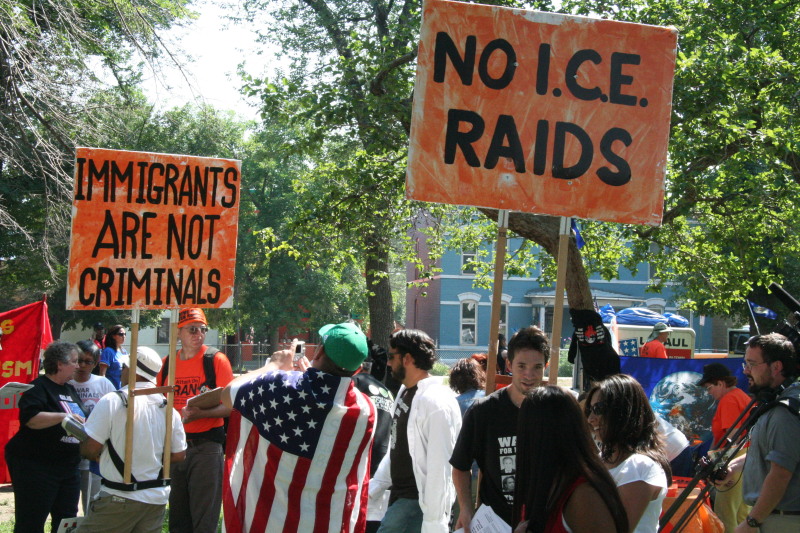
Under the Trump administration, Immigration and Customs Enforcement (ICE) agents are conducting ongoing raids of schools, workplaces, and residential neighborhoods in major U.S. cities, searching for immigrants to arrest and prosecute.[1] In response to the Trump administration’s deportation agenda, the Department of Homeland Security (DHS) started targeting landlords for their tenants’ “leases, rental applications and identification cards.”[2] Oftentimes, DHS uses subpoenas to intimidate landlords into revealing their tenants’ information; however, there have been multiple reports of such subpoenas being served without a judge’s signature.[3] Even when the subpoenas are unsigned,[4] they contribute to the pressure that DHS is exerting on landlords, which is likely to exacerbate existing discrimination.[5]
II. Immigration Enforcement Practices Undermine Fair Housing Protections
President Johnson signed the Fair Housing Act (FHA) into law in 1968,[6] following years of support from civil rights activists.[7] The FHA prohibits landlords from discriminating against tenants on the basis of race, color, religion, sex, national origin, familial status, and disability.[8] However, the FHA does not protect against discrimination on the basis of immigration status.[9] The gaps in the fair housing framework permit landlords to request immigration documentation from applicants for tenancy, provided they follow the same procedure for every applicant; otherwise, it may constitute unlawful discrimination based on national origin.[10] Some states, such as California, Illinois, and Oregon, have explicitly encoded protection for immigration status into their housing laws.[11] In other states, like Colorado, the judicial system acts as an additional safeguard for tenants’ privacy rights, such as when a Colorado judge issued a preliminary injunction against a landlord who threatened to notify immigration enforcement of his tenants’ pending immigration status.[12] The Fair Housing Act’s protections are falling short when immigration enforcement pushes the boundaries of acceptable housing practices. [13]
III. The Current Legal Framework for Immigration Status Protection
Currently, threatening to report a person to ICE in retaliation for reporting housing discrimination is illegal under the FHA.[14] However, immigration status is not a protected class under the FHA; therefore, the law protects only individuals who report housing discrimination based on race or national origin, rather than immigration status.[15] This allows landlords to discriminate against immigrants who are here on a temporary visa or who are undocumented.[16]
If landlords bow to the pressures of ICE and turn immigrants away from housing opportunities, immigrants will have few choices for housing left, leading them to accept housing arrangements in shared housing spaces, which are often illegal or on a no-lease basis.[17] These housing arrangements leave immigrants with limited legal options to address certain wrongs committed against them, such as eviction or the violation of their right to quiet enjoyment of the premises.[18] The FHA grants fair housing rights to everyone in the U.S., not just citizens.[19] The lack of protection for immigration status under the FHA, coupled with a potential resort to makeshift housing arrangements with reduced legal oversight, highlights the vulnerability of the FHA. However, strengthening fair housing rights will require legal recourse.[20] One option is to make discrimination based on immigration status explicitly illegal under the FHA.[21] Another option would be for states to take the matter into their own hands and join California, Illinois, and Oregon in recognizing immigration status as a protected class under their state fair housing laws and state constitutions.[22]
IV. Conclusion
The rights guaranteed by the FHA apply to every person in the United States, not solely to citizens.[23] Given the current climate of immigration enforcement and its potential impact on housing practices, the nation’s current legal framework won’t be sufficient to guarantee nondiscriminatory housing for immigrants of all legal statuses.[24] The FHA not only prohibits housing discrimination on the basis of a protected class,[25] but also provides legal recourse when a housing provider violates its provisions.[26] The federal government, or alternatively, the states, should enshrine protections for immigration status to realize the goal of protecting fair housing rights for all.
*Sophie Alemi is a second-year student at the University of Baltimore School of Law where she is a staff editor for Law Review, Vol. 55 and a student advocate on the National Mock Trial Team. Previously, she was a Teaching Assistant for Introduction to Lawyering Skills and an intern at the Maryland Office of the Public Defender. She looks forward to a career protecting indigent defendants and civil rights.
[1] See Sophia Tareen, Immigration Agents Become Increasingly Aggressive in Chicago, PBS NEWS (Oct. 6, 2025, at 14:07 ET), https://www.pbs.org/newshour/nation/immigration-agents-become-increasingly-aggressive-in-chicago; The ICE Raids — What You Need to Know,HIAS (June 27, 2025), https://hias.org/news/ice-raids-what-you-need-know/.
[2] Jesús Jank Curbelo, Pressuring Landlords to Hand over Tenant Records: Trump’s New Strategy to Track Migrants, EL PAÍS (July 18, 2025, at 6:27 ET), https://english.elpais.com/usa/2025-07-18/pressuring-landlords-to-hand-over-tenant-records-trumps-new-strategy-to-track-migrants.html.
[3] Id.
[4] ACLU, Know Your Rights: Immigration Administrative Subpoenas, https://assets.aclu.org/live/uploads/2025/04/ACLU-KYR-on-ICE-administrative-subpoenas-4.17.25.pdf (last visited Jan. 30, 2026) (“[F]or ICE subpoenas, there are no consequences for an initial failure to comply. Only if a court orders you to comply and you subsequently fail to do so can penalties be imposed.”).
[5] Curbelo, supra note 2.
[6] Fair Housing Act §§ 801–901, 42 U.S.C. §§ 3601–3631.
[7] History, The Fight for Fair Housing in the House: A ‘Long, Tortuous, and Difficult Road,’ U.S. HOUSE OF REPRESENTATIVES (Apr. 28, 2021), https://history.house.gov/Blog/2021/April/4-28-FHA/.
[8] Fair Housing Act §§ 801–901, 42 U.S.C. § 3604.
[9] Francis Nguyen, For Immigrant Households, Fear of Arrest and Deportation Erodes Tenants Rights, SHELTERFORCE (Sep. 5, 2025), https://shelterforce.org/2025/09/05/for-immigrant-households-fear-of-arrest-and-deportation-erodes-tenants-rights.
[10] Id.
[11] See Nguyen, supra note 9.
[12] Id.
[13] See Id.
[14] Immigration Protections in Housing, Fair Hous. Just. Center, https://fairhousingjustice.org/wp-content/uploads/2024/01/FHYA-Handout-Immigration.pdf (last visited Jan. 11, 2026).
[15] Id.
[16] See id.
[17] Mekonnen Firew Ayano, Tenants Without Rights: Situating the Experiences of New Immigrants in the U.S. Low-Income Housing Market, Geo. J. on Poverty L. & Pol’y, 159, 161 (2008), https://www.law.georgetown.edu/poverty-journal/wp-content/uploads/sites/25/2021/07/159-Ayano-Tenants-Without-Rights.pdf.
[18] Id. at 162, 167.
[19] Fair Housing & Citizenship: Can You Deny an Applicant?,Fair Hous. Institute, https://fairhousinginstitute.com/fair-housing-citizenship-deny-applicant/ (last visited Jan. 11, 2026).
[20] See Nguyen, supra note 9.
[21] See Fair Hous. Institute, supra note 19; see also Nguyen, supra note 9 (demonstrating that states can effectively protect immigrants through their fair‑housing laws, thereby creating a model for potential federal action).
[22] See Nguyen, supra note 9.
[23] See Fair Hous. Institute, supra note 19.
[24] See Nguyen, supra note 9.
[25] See Nguyen, supra note 9.
[26] Fair Housing Act §§ 801–901, 42 U.S.C. § 3631.
 University of Baltimore Law Review