
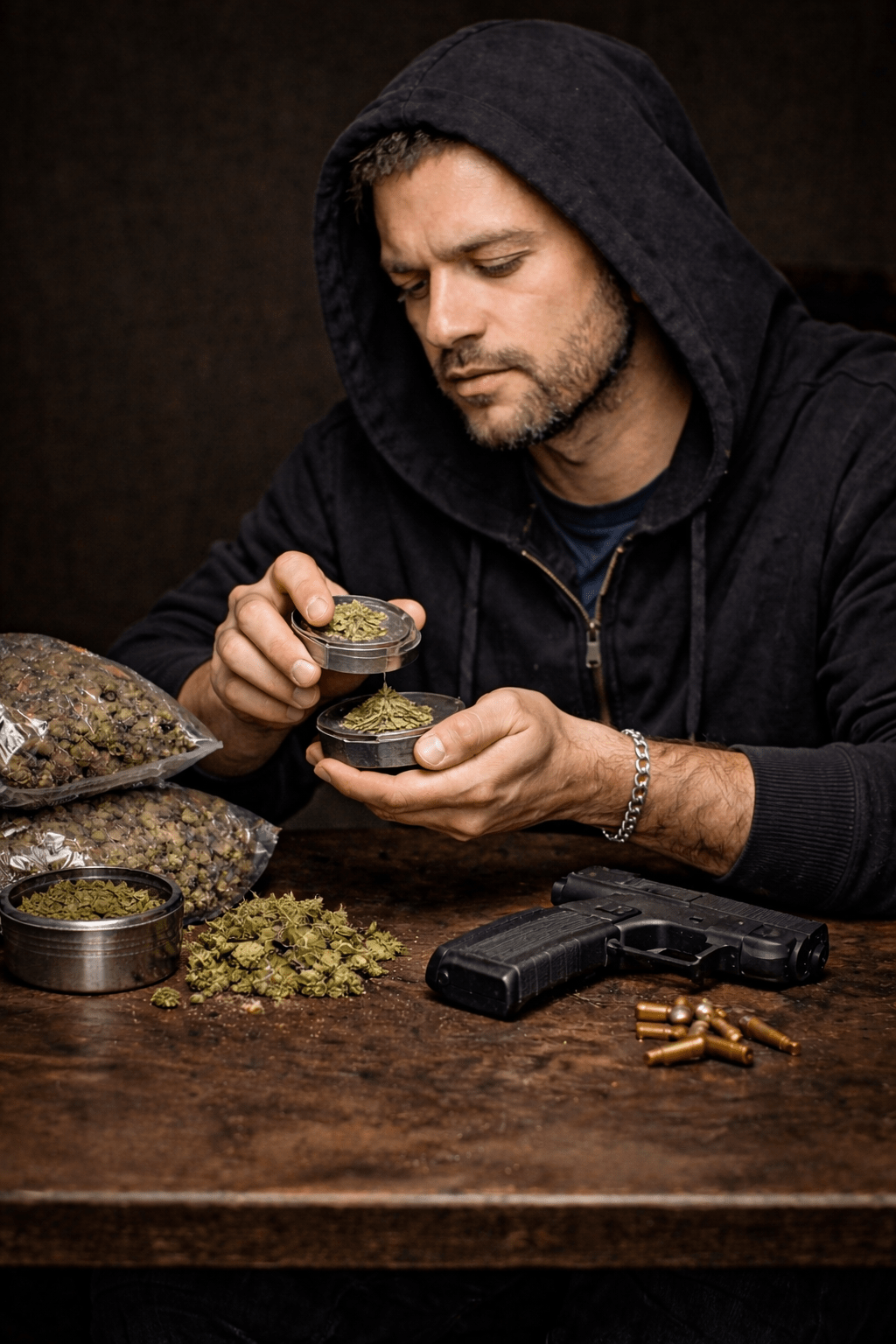
*Tyler Konigsberg
I. Introduction: The Constitutional Challenge to 18 U.S.C. § 922(g)(3) and Its Implications for Marijuana Users.
At a time when marijuana legalization and Second Amendment doctrine increasingly collide, the Supreme Court granted certiorari in United States v. Hemani, positioning the Court to clarify the constitutional limits of firearm prohibitions tied to unlawful drug use.[1] The Fifth Circuit held § 922(g)(3) unconstitutional as applied to a sober person with no history of firearm misuse.[2] The case asks whether 18 U.S.C. § 922(g)(3), which bars firearm possession by anyone “who is an unlawful user of. . . [a] controlled substance[,]” including marijuana, “violates the Second Amendment, as applied to the respondent.[3] The Court will hear the case in March, with a decision likely by early summer.[4]
II. Courts Are Divided Over Whether § 922(g)(3) May Disarm Marijuana Users, Which Affects Millions of Americans.
Courts applying § 922(g)(3) have adopted fundamentally different views of when marijuana use justifies disarmament, with some requiring proof of present dangerousness and others permitting broader categorical restrictions.[5] The Third Circuit permits § 922(g) restrictions to be applied only to those who pose a “special danger” of firearm misuse due to frequent drug use.[6] The Fifth Circuit held that the statute is unconstitutional as applied to a sober person because history supports disarming only the “presently intoxicated.”[7] Meanwhile, the Sixth Circuit permits the government to “disarm drug users [under] § 922(g)(3)” on the ground that they are dangerous, “‘so long as each’ [affected individual] ‘has an opportunity to make an individualized showing that he. . . is not actually dangerous.’”[8] The Seventh Circuit permits disarming a “persistently and presently impaired” user, analogizing to severe mental illness.[9] The Eighth Circuit rejected a categorical ban and held that § 922(g)(3) is constitutional only if the government proves the person’s drug use made them “act like someone who is ‘both mentally ill and dangerous’” or that they “pose[d] a credible threat to the physical safety of others.”[10] And the Tenth Circuit ruled that “legislatures may disarm those believed to pose a risk of future danger” and remanded to determine whether a non-intoxicated marijuana user meets that threshold.[11] These conflicting approaches leave the scope of Second Amendment protections subject to geographic variation, underscoring the need for Supreme Court review.[12]The resulting patchwork of circuit decisions produces inconsistent and unstable constitutional standards, making such review unavoidable.[13]
III. Gun Regulation for Cannabis Must Be Evaluated Under the Bruen Historical-Tradition Test.
In New York State Rifle and Pistol Ass’n v. Bruen, the Court held that when a firearm regulation is challenged, the government must show the law is consistent with the “[n]ation’s historical tradition of firearm regulation.”[14] Although Bruen concerned firearms, its rule governs how courts evaluate modern laws that restrict the exercise of constitutional rights based on historical practice.[15] That framework is directly implicated when the federal government disarms individuals based solely on marijuana use, a substance that was widely lawful for most of the Nation’s history.[16]
Federal marijuana regulation began with the Marihuana Tax Act of 1937.[17] Before that, cannabis was widely lawful.[18] In the U.S. today, an estimated thirty-two percent of Americans are gun owners,[19] and about fifteen percent of Americans smoke marijuana.[20] Additionally, nearly half of the states permit or regulate recreational marijuana use, and forty states allow marijuana for medical purposes.[21] During the 2024 election season, a majority of Florida voters supported a marijuana legalization amendment, although it fell short of the sixty percent threshold required for constitutional change.[22] President Donald Trump supported legalization while Governor Ron DeSantis opposed it, showing that marijuana reform divides even leading conservatives.[23] Therefore, there is no founding-era tradition of disarming cannabis users or other nonviolent individuals based solely on substance use.[24]
By contrast, the right to keep and bear arms has deep constitutional roots.[25] The Second Amendment was ratified in 1791.[26] The conflict arises because § 922(g)(3) treats marijuana use itself as a proxy for dangerousness, despite the absence of any historical tradition of disarming nonviolent individuals and despite widespread modern legalization of marijuana.[27] A person who uses cannabis to sleep or manage chronic pain may not be dangerous.[28] Yet, that person risks imprisonment for firearm possession.[29] Meanwhile, a person who drinks wine before bed faces no such federal consequence.[30] Many see those behaviors as similar.[31]
IV. Conclusion: There Is a Strong Argument that § 922(g)(3) Is Unconstitutional When Applied to All Marijuana Users.
In sum, the statute sweeps too broadly, criminalizing individuals who are neither intoxicated nor dangerous.[32] The Court may adopt an as-applied approach and hold that the law is unconstitutional when the person is not intoxicated, has no history of misuse, and is not mentally ill.[33] Vagueness concerns also persist because the statute does not define who counts as a current “user.”[34]
Even strict originalists, such as Justice Thomas, have questioned the logic of outdated federal marijuana laws.[35] Support for reform spans across the political spectrum.[36] The Court’s ruling will ultimately define the boundary between public safety and personal liberty in the era of widespread state legalization.[37] Without Supreme Court intervention, the constitutionality of § 922(g)(3) will continue to depend on geography rather than history.[38]
*Tyler Konigsberg is a second year student at the University of Baltimore School of Law. He is a Distinguished Scholar of the Royal Graham Shannonhouse III Honor Society. He serves as a Teaching Assistant for Civil Procedure I and Introduction to Lawyering Skills, and as a Property Law Scholar. He is also a Staff Editor on the University of Baltimore Law Review. Tyler received a Bachelor of Business Administration, magna cum laude, from Babson College. He spent the past summer as a Summer Law Clerk at Silverman Thompson Slutkin White. He is currently interning with the Chief Justice of the Supreme Court of Maryland. Following his second year of law school, he will join Nelson Mullins Riley and Scarborough LLP as a Summer Associate. After graduation, he will clerk at the Supreme Court of Maryland for the Honorable Justice Brynja Booth.
[1] United States v. Hemani, No. 24-40137, 2025 WL 354982 (5th Cir. Jan. 31, 2025), cert. granted, No. 24-1234, 2025 WL 2949569 (U.S. Oct. 20, 2025); see also Lindsay Whitehurst, Supreme Court Will Consider Whether People Who Regularly Smoke Pot Can Legally Own Guns, The Associated Press, (Oct. 20 2025, at 12:14 ET), https://apnews.com/article/supreme-court-marijuana-guns-e86c342bf248c7822722ad027980b72b (explaining that the U.S. Supreme Court will consider whether people who use marijuana can legally own guns under federal law, a challenge to 18 U.S.C. § 922(g)(3)).
[2] Hemani, 2025 WL 354982, at *1.
[3] Petition for Writ of Certiorari, Hemani, 2025 WL 1593262, at *I, *5 (No. 24-1234). Section 922(d)(3) bars licensed sellers from transferring a firearm to a person the seller knows or has reason to believe is an unlawful drug user. See 18 U.S.C. § 922(d)(3). Section 922(g)(3) regulates the possessor. See id. § 922(g)(3).
[4] Whitehurst, supra note 1; United States v. Hemani, SCOTUSblog, https://www.scotusblog.com/cases/case-files/united-states-v-hemani/ (last visited Feb. 9, 2026).
[5] See infra notes notes 6–11 and accompanying text.
[6] United States v. Harris, 144 F.4th 154, 156 (3d Cir. 2025).
[7] Hemani, 2025 WL 354982, at *1; United States v. Connelly, 117 F.4th 269, 272 (5th Cir. 2024).
[8] United States v. VanOchten, 150 F.4th 552, 558 (6th Cir. 2025) (quoting United States v. Williams, 113 F.4th 637, 663 (6th Cir. 2024)).
[9] United States v. Seiwert, 152 F.4th 854, 869 (7th Cir. 2025).
[10] United States v. Cooper, 127 F.4th 1092, 1096 (8th Cir. 2025) (quoting United States v. Rahimi, 602 U.S. 680, 700 (2024)).
[11] United States v. Harrison, 153 F.4th 998, 1035 (10th Cir. 2025).
[12] See supra notes 6–11 and accompanying text.
[13] See supra notes 6–11 and accompanying text.
[14] N.Y. State Rifle & Pistol Ass’n v. Bruen, 597 U.S. 1, 17 (2022).
[15] See id.
[16] Cf. id (explaining that courts must assess modern firearm regulations by asking whether they are consistent with historical tradition at the time of the Founding).
[17] Did You Know… Marijuana Was Once a Legal Cross-Border Import?, U.S. Customs & Border Prot. (Jan. 22, 2026), https://www.cbp.gov/about/history/did-you-know/marijuana.
[18] Id.
[19] What Percentage of Americans Own Guns?, Gallup News (Nov. 13, 2020), https://news.gallup.com/poll/264932/percentage-americans-own-guns.aspx.
[20] What Percentage of Americans Smoke Marijuana?, Gallup News (Nov. 1, 2024), https://news.gallup.com/poll/284135/percentage-americans-smoke-marijuana.aspx.
[21] State Medical Cannabis Laws, NAT’L CONF. OF STATE LEGISLATURES, (June 27, 2025), https://www.ncsl.org/health/state-medical-cannabis-laws.
[22] Stephany Matat, Florida Rejects Abortion and Marijuana Ballot Measures as State Sees Major Shift to the Right, PBS News (Nov. 5, 2024, at 21:18 ET), https://www.pbs.org/newshour/politics/florida-rejects-abortion-ballot-measure-as-state-sees-major-shift-to-the-right; David Ovalle, Florida Voters Fall Short in Push to Legalize Recreational Marijuana, Wash. Post (Nov. 6, 2024), https://www.washingtonpost.com/health/2024/11/05/florida-marijuana-vote-election/.
[23] Dara Kam, Florida’s Recreational Marijuana Amendment Falls Short of Passage, WUSF (Nov. 5, 2024, at 21:07 ET), https://www.wusf.org/politics-issues/2024-11-05/florida-voters-reject-ballot-initiative-legalize-recreational-marijuana; Mitch Perry, Trump Makes it Official: He’s Voting for Legalizing Cannabis in Florida, Florida Phoenix (Sep. 9, 2024, at 09:11 ET), https://floridaphoenix.com/2024/09/09/trump-makes-it-official-hes-voting-for-legalizing-cannabis-in-florida/.
[24] Jacob Sullum, 5th Circuit Says Prosecuting a Cannabis Consumer for Possessing Guns Violated the Second Amendment, Reason (Aug. 11, 2023, at 15:30 ET), https://reason.com/2023/08/11/5th-circuit-says-prosecuting-a-cannabis-consumer-for-possessing-guns-violated-the-second-amendment/.
[25] See Constitutional Amendments – Amendment 2 – “The Right to Keep and Bear Arms”, RONALD REAGAN Presidential Libr. & Museum, https://www.reaganlibrary.gov/constitutional-amendments-amendment-2-right-keep-and-bear-arms (last visited Jan. 23, 2026).
[26] Dave S. Sidhu, The Second Amendment at the Supreme Court: Challenges to Federal Gun Laws, CONGRESS.GOV (Nov. 24, 2025), https://www.congress.gov/crs-product/LSB11108.
[27] Contra Kyle Jaeger, Florida Case on Medical Marijuana Patients’ Gun Rights Is on Hold as Supreme Court Weighs Underlying Issue, Marijuana Moment (Oct. 27, 2025), https://www.marijuanamoment.net/florida-case-on-medical-marijuana-patients-gun-rights-is-on-hold-as-supreme-court-weighs-underlying-issue/ (noting thatthe government’s position, which maintains that § 922(g)(3) constitutionally targets “habitual users of unlawful drugs” as categorically dangerous and has urged courts to stay challenges pending the Supreme Court’s resolution of United States v. Hemani).
[28] Cf. Gun Ownership and Medical Marijuana: Unexpected Barriers to Certain Treatments for Chronic Pain, Clev. Clinic: ConsultQD (Aug. 25, 2022), https://consultqd.clevelandclinic.org/gun-ownership-and-medical-marijuana-unexpected-barriers-to-certain-treatments-for-chronic-pain (noting that some patients rely on medical marijuana to manage chronic pain but face firearm restrictions).
[29] Cf. id. (noting that some patients rely on medical marijuana to manage chronic pain but face firearm restrictions).
[30] In Which States Can You Concealed Carry and Drink Alcohol?, U.S. Concealed Carry Ass’n (Dec. 29, 2019), https://www.usconcealedcarry.com/blog/in-which-states-can-you-concealed-carry-and-drink-alcohol/.
[31] Amiah Taylor, Alcohol vs Weed: How Similar Are Their Effects on the Body?, Discover Mag. (Dec. 7, 2022, at 04:00 ET), https://www.discovermagazine.com/are-the-effects-of-cannabis-and-alcohol-in-the-body-the-same-44362.
[32] See Jaeger, supra note27.
[33] See United States v. Harris, 144 F.4th 154, 162 (3d Cir. 2025).
[34] See 18 U.S.C. § 922(d)(3); Vagueness Doctrine, Corn. L. Sch.: Legal Information Institute, https://www.law.cornell.edu/wex/vagueness_doctrine (last visited Jan. 23, 2026) (explaining that laws may be void for vagueness when they fail to give ordinary people fair notice of what conduct is prohibited).
[35] Annika Kim Constantino, Supreme Court Justice Clarence Thomas Says Federal Marijuana Laws May Be Outdated, CNBC (June 28, 2021, at 21:03 ET), https://www.cnbc.com/2021/06/28/supreme-court-justice-clarence-thomas-says-federal-marijuana-laws-may-be-outdated-.html.
[36] See Most Americans Favor Legalizing Marijuana for Medical, Recreational Use, Pew Rsch. Ctr. (Mar. 26, 2024), https://www.pewresearch.org/politics/2024/03/26/most-americans-favor-legalizing-marijuana-for-medical-recreational-use/.
[37] See supra Parts I–III.
[38] See supra notes 6–11 and accompanying text.
 University of Baltimore Law Review