
*Calista Heister
I. Introduction
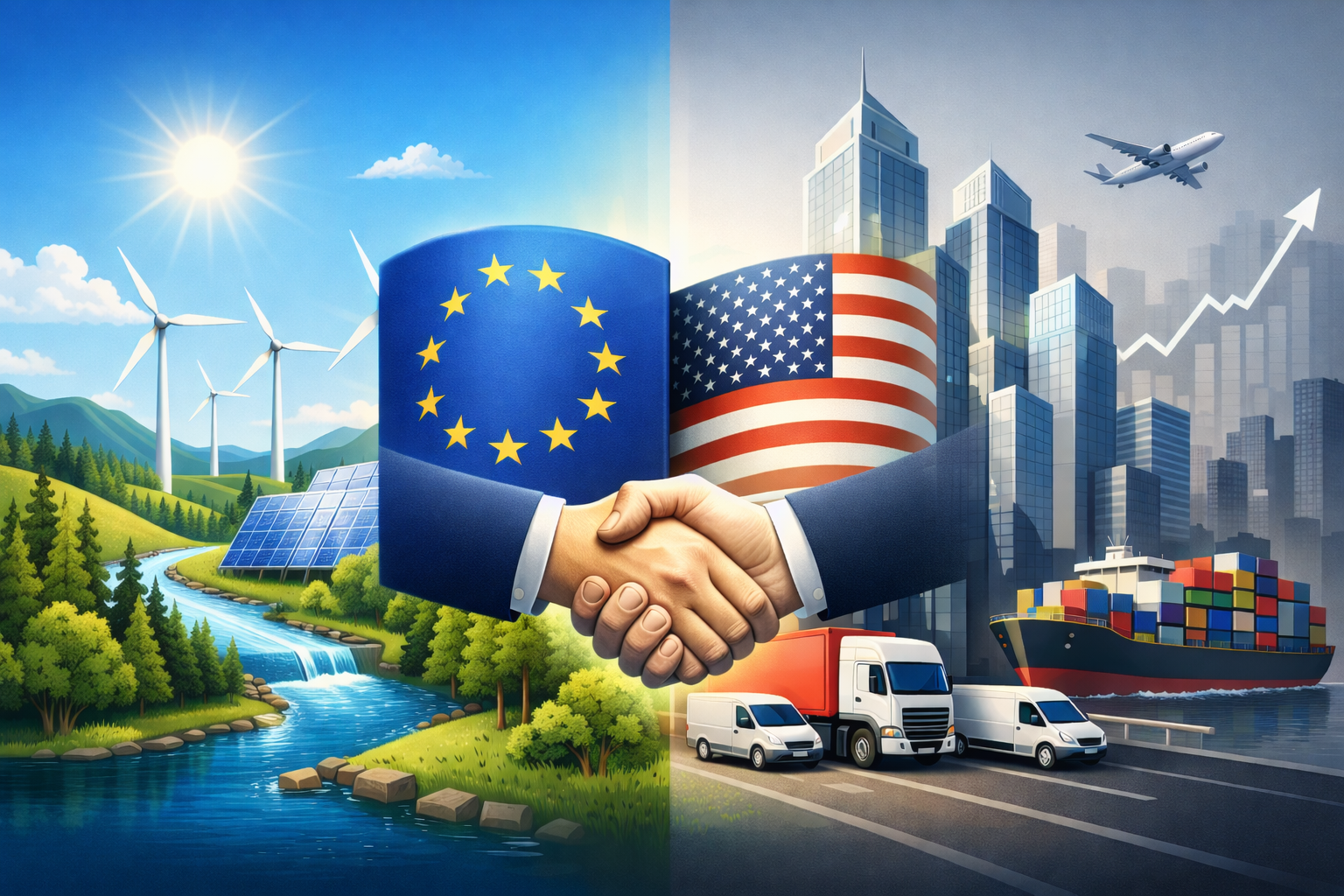
In January 2026, the European Union Commission implemented the Carbon Border Adjustment Mechanism (CBAM) Regulation, which regulates imports with high carbon emissions entering the European Union (EU) to reduce the risk of carbon leakage.[1] The CBAM Regulation, which has been in a transitional period since 2023,[2] exemplifies the Brussels Effect’s impact on the spread of trade policies and regulations among EU member States.[3] If the United States wants to trade with EU member States, it may need to implement a CBAM of its own to comply with EU standards.[4] President Trump believes the EU’s CBAM Regulation serves as an “unfair trad[ing] practic[e].”[5] However, the potential effects of CBAM on the United States are “overstat[ed]” as many American exporters already meet the EU requirements.[6]
II. European Union’s Carbon Border Adjustment Mechanism
The EU Commission, which is “in charge of the implementation and enforcement of EU legislation,”[7] implemented Regulation 2023/956, the CBAM, to reduce the effects of carbon emissions from imported goods into the EU.[8] The CBAM imposes a fee on EU imports based on the quantity of greenhouse gases emitted during the production process.[9] The CBAM will apply to items that pose a high risk of carbon leakage,[10] and EU businesses will need to report the amount of imported goods, the “direct and indirect emissions embedded in them”, and the carbon price owed for emissions.[11] The CBAM will not only help put a fair price on the carbon emitted by goods imported into the EU, but will also encourage non-EU member States to produce cleaner goods.[12] The regulation was in a transitional period to address concerns and issues in the initial regulation, but as of January 2026, it has taken full effect.[13]
III. The Brussels Effect’s Spillover of EU Regulations to the United States
The Brussels Effect is a trend in which global companies must comply with EU regulations to retain trade access to the world’s most lucrative single market.[14] The EU aims to implement environmental standards to improve the state of global climate change[15]by creating regulations that achieve two goals:[16] EU regulations should further environmental goals as well as “advance[] a single market . . . to ensure free movement of goods” in the EU.[17] The Brussels Effect is particularly influential regarding the EU’s CBAM, as the United States may need to implement federal standards that align with those of the CBAM if it wants to continue to benefit from trade with EU member States without increased fees on its goods and products.[18] The United States tends to be less pro-regulation than the EU, which makes it harder to pass federal regulations, but the spillover tends to occur anyway to protect market accessibility.[19]
IV. The United States and CBAM
The difference in regulatory perceptions in the United States compared to the EU[20] aligns with the United States distrust of the CBAM’s purpose.[21] The United States has stated that the CBAM “imposes costly verification measures . . . and [t]hese EU regulations undermine fair competition, penalizing U.S. companies.”[22] While the United States has shown fierce opposition to the CBAM, modelling indicates that there is potential for profit from the CBAM if the United States decides to implement its own version domestically.[23] President Trump spreads misinformation that contradicts the predicted minimal impacts on United States exporters, as indicated by environmental analysts.[24] Many American companies already adhere to many of the guidelines regarding carbon emissions and products subject to the EU CBAM.[25]
Furthermore, the United States can “further reduce CBAM compliance costs” for goods in high carbon emission industries by implementing its own federal version of a CBAM, therefore aligning itself with EU regulations through federal standards.[26] “As the world’s largest crude oil producer and liquefied natural gas exporter and the second-largest emitter of greenhouse gases (GHGs), the United States bears a substantial responsibility to address global carbon dioxide (CO2) emissions.”[27] The United States needs to design a feasible CBAM to remain competitive with other strong States, such as “Japan, Turkiye, and the UK[,] [who are all creating] their own version[s].”[28] Not only would a domestic CBAM promote “environmental sustainability on a global scale”, but “[a] potential U.S. CBAM can serve as a vital tool in the nation’s effort to transition toward a net-zero economy” and retain access to EU trading partners.[29]
V. Conclusion
While the EU’s pending CBAM implementation has caused concern for the United States regarding “unfair trad[ing] practices,”[30] the current administration has “overstated” the adverse effects on American companies. Because many United States exporters have adopted production practices compliant with the CBAM, the impact is predicted to be minimal.[31] The Brussels Effect pressures the United States to implement a domestic CBAM of its own so that companies can comply with EU regulations and avoid increased operational costs to meet compliance requirements.[32]
*Calista Heister is a second-year student at the University of Baltimore School of Law and a Staff Editor on Law Review. She also is the 2L representative for the International Law Society and UB Leads Mentor. Calista interned with Justice Booth of the Supreme Court of Maryland this past summer and has also participated in the Sports Law Arbitration Moot Competition through the Entertainment, Arts and Sports Law Society. She hopes to work in international business transactions to help companies align their trade and labor practices with human rights standards.
[1] Carbon Border Adjustment Mechanism, Eur. Comm’n, https://taxation-customs.ec.europa.eu/carbon-border-adjustment-mechanism_en (last visited Jan. 24, 2026).
[2] Id.
[3] Anu Bradford, The Brussels Effect: How the European Union Rules the World 10–11, 23 (2020), https://doi-org.proxy-bl.researchport.umd.edu/10.1093/oso/9780190088583.001.0001 (explaining that the Brussels Effect is when EU regulations become a global standard because States implement the most stringent regulations to retain access to global trade markets).
[4] Sanam Rasool, William Alan Reinsch & Thibault Denamiel, Crafting a Robust U.S. Carbon Border Adjustment Mechanism, CTR. FOR STRATEGIC & INT’L STUD.
(Aug. 8, 2024), https://www.csis.org/analysis/crafting-robust-us-carbon-border-adjustment-mechanism.
[5] Chris Knight, US Faults EU Carbon Fee During Tariff Fight, argus (Aug. 4, 2024), https://www.argusmedia.com/en/news-and-insights/latest-market-news/2676398-us-faults-eu-carbon-fee-during-tariff-fight.
[6] See Sarah George, Trump ‘Overstating EU Carbon Tax Threat by More Than $4bn’, edie (Sep. 24, 2025), https://www.edie.net/trump-overstating-eu-carbon-tax-threat-by-more-than-4bn/.
[7] Bradford, supra note 3, at 8–9.
[8] Carbon Border Adjustment Mechanism (CBAM), Eur. Comm’n (Oct. 17, 2023), https://trade.ec.europa.eu/access-to-markets/en/news/carbon-border-adjustment-mechanism-cbam [hereinafter CBAM].
[9] Raymond J. Kopp, William Pizer & Kevin Rennert, Carbon Border Adjustments: Design Elements, Options, and Policy Decisions, RESOURCES for the FUTURE (Oct. 10, 2023), https://www.rff.org/publications/reports/carbon-border-adjustments-design-elements-options-and-policy-decisions/.
[10] Id. (including imports such as “cement, iron and steel, aluminum, fertilizers, electricity, and hydrogen”).
[11] Id.
[12] Eur. Comm’n, supra note 1.
[13] CBAM, supra note 8.
[14] Jan Stappers, What is the Brussels Effect?, NAVEX (Feb. 13, 2024), https://www.navex.com/en-us/blog/article/what-is-the-brussels-effect/.
[15] Id.
[16] Bradford, supra note 3, at 9.
[17] Id. at 9–10.
[18] Preparing for a US CBAM, CARBON COMPLETE, https://carboncomplete.com/preparing-for-a-us-cbam/ (last visited Jan. 24, 2026).
[19] Bradford, supra note 3, at 39.
[20] Id.
[21] George, supra note 6 (explaining that Trump thinks that the CBAM is the EU’s way of implementing trade practices that are unfair to the United States).
[22] United States Trade Representative (@USTradeRep), X (Apr. 7, 2025, at 15:26 ET), https://x.com/USTradeRep/status/1909326878726365215.
[23] US Companies Have No Reason to Complain About CBAM, Says Report, SustainableViews (Sep. 24, 2025), https://www.sustainableviews.com/us-companies-have-no-reason-to-complain-about-cbam-says-report-fe2c3eef/.
[24] George, supra note 6.
[25] Id.
[26] Id.
[27] Rasool, Reinsch & Denamiel, supra note 4.
[28] CARBON COMPLETE, supra note 18.
[29] Rasool, Reinsch & Denamiel, supra note 4.
[30] Knight,supra note 5.
[31] George, supra note 6.
[32] CARBON COMPLETE, supra note 18.



 University of Baltimore Law Review