*Sabrina Marquez
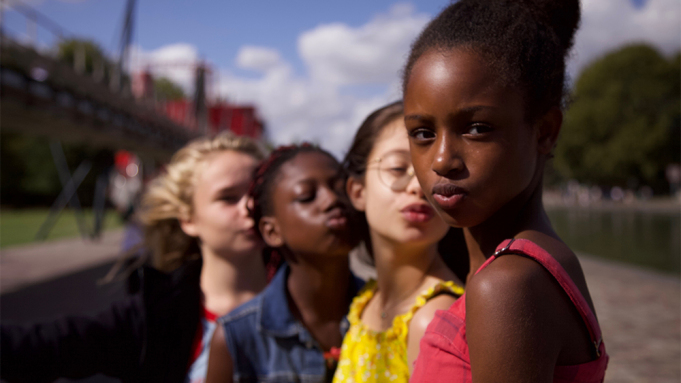
The First Amendment’s protection of free speech is in contention as a small county in Texas charged Netflix, Inc. (Netflix) with the state felony of promoting lewdness for content displayed in the movie “Cuties.”[1] The movie is a French film by Maïmouna Doucouré, also known as “Mignonnes,”and functions as an extension of her short film “Maman(s).”[2] Cuties follows the journey of an eleven-year-old Muslim immigrant from Senegal named Amy and her struggle with identity as she joins a group attempting to win a local dance contest.[3] Amy’s story brings to light the hyper-sexualization of young children and their vulnerabilities during such an explorative time.[4]
Before the film’s release on Netflix, controversy began with the original artwork used for promotion, which depicted the main characters in their dance costumes.[5] Once the film was released, the platform experienced extreme backlash from viewers worldwide.[6] Many viewers are now calling for the film to be removed from the streaming service and threatening to boycott Netflix.[7] In the movie, Amy and her friends are shown in revealing clothes while “twerking” and learning other provocative dances.[8] These scenes were intended to demonstrate how modern media and the sexualization of girls impacts young children; however, the message did not quite register and the film has since been heavily criticized as child pornography.[9]
A grand jury in Tyler County, Texas, indicted Netflix for the promotion of lewd material depicting a child under Texas Penal Code § 43.262(b).[10] That statutory provision reads as follows:
A person commits an offense if the person knowingly possesses, accesses with intent to view, or promotes visual material that:
(1) depicts the lewd exhibition of the genitals or pubic area of an unclothed, partially clothed, or clothed child who is younger than 18 years of age at the time the visual material was created;
(2) appeals to the prurient interest in sex; and
(3) has no serious literary, artistic, political, or scientific value.[11]
The statute combines the obscenity standard coined in the landmark Supreme Court case Miller v. California[12] and federal child pornography law.[13] The First Amendment safeguards obscene material so long as the work has serious artistic value, but child pornography is excluded from this protection.[14]
For the Texas statute to be satisfied, the material must depict a minor’s genitals, clothed or unclothed.[15] In the film, the main character and her dance crew are shown in crop tops and short shorts, but their genitals are never on screen.[16] Additionally, the film does not appeal to the prurient interest of sex.[17] The young actresses are not participating in sex acts or sexual conduct, they are only seen learning explicit dances.[18] Even if a court finds the first two prongs are met, to sustain a conviction under the Texas statute, the work as a whole must have no serious literary, artistic, political, or scientific value.[19] Tyler County District Attorney, Lucas Babin, will have an uphill battle trying to prove the film lacks serious artistic value as Doucouré’s Manans, from which Cuties is adapted, is an award winning, critically acclaimed film.[20] Those awards include the Sundance International Fiction Jury Award, Best Short Film at the Toronto International Film Festival, and the 2017 Cèsar Award for Best Short Film.[21] Additionally, Cuties is a rumored nominee for the International Featured Film category of the 2021 Academy Awards.[22]
If Netflix is convicted of promoting lewd material depicting a child, the ruling may have a detrimental impact on freedom of speech.[23] The statute applies to the lewd depiction of anyone under the age of eighteen that appeals to a prurient interest in sex.[24] If the Texas court finds the statute applicable to the film Cuties for showing young girls dancing in provocative clothing, where would courts down the road draw the line?[25] Would Texas prosecutors then have the authority to charge participants of child beauty pageants for promoting lewdness?[26] Or teenagers who post provocative dances of themselves on platforms like TikTok and Instagram?[27] Cuties was a thought-provoking film on the impact of modern media that forced the audience to be uncomfortable.[28] Although the movie teetered the line of inappropriateness, it did not go as far as producing child pornography and therefore, due to the film’s artistic value, it should be protected under the First Amendment.[29]
*Sabrina Marquez is a second-year day student at the University of Baltimore School of Law, where she is a staff editor for Law Review. Sabrina is a teaching assistant for Professor William Hubbard’s Introduction to Lawyering Skills course, President of the Latin American Law Students Association, and Community Service Director for the Student Bar Association. Last summer, Sabrina interned for the Hon. Douglas R. M. Nazarian in the Maryland Court of Special Appeals. This upcoming summer, Sabrina will be summer associate for Baker, Donelson, Bearman, Caldwell & Berkowitz P.C.
[1] See Indictment, Texas v. Netflix, Inc., No. 13731, 2020 WL 5995262 (Tex. Dist. Sept. 23, 2020); see also Mike Godwin, Texas Grand Jury Indicts Netflix Over Cuties, Doesn’t Understand First Amendment, Slate: Tech. (Oct. 9, 2020, 6:06 PM), https://slate.com/technology/2020/10/cuties-netflix-texas-indictment-lewd-visual-material-first-amendment.html.
[2] See Amy Nicholson, ‘Cuties’: Film Review, Variety (Jan. 23, 2020, 7:30 PM), https://variety.com/2020/film/reviews/cuties-review-1203476991/.
[3] See Cuties, Sundance Inst., https://www.sundance.org/projects/cuties (last visited Jan. 21, 2021).
[4] See id.
[5] See Vulture Editors, Wait, What’s Going on With Netflix and Cuties?, Vulture (Oct. 7, 2020), https://www.vulture.com/2020/10/netflix-cuties-twerking-poster-drama-explained.html (“It used a picture of a young Senegalese Muslim character, Amy, along with the titular Cuties — the dance crew of cool girls from her middle school in Paris — in spandex dance costumes (short-shorts and metallic crop tops).”).
[6] See Cuties: Netflix Apologises for Promotional Poster After Controversy, BBC (Aug. 20, 2020), https://www.bbc.com/news/entertainment-arts-53846419.
[7] See Caitlyn Green, “Cuties” and #CancelNetflix: Is It Worth the Controversy?,Suffolk J. (Sept. 22, 2020), https://thesuffolkjournal.com/30062/ac/film/cuties-and-cancelnetflix-is-it-worth-the-controversy/.
[8] See id.
[9] See Maria Cramer, Netflix Is Charged in Texas with Promoting Lewdness in ‘Cuties’, N.Y. Times (Oct. 7, 2020), https://www.nytimes.com/2020/10/07/business/cuties-netflix-texas.html.
[10] Id.
[11] Tex. Penal Code Ann. § 43.262(B) (West, through the end of 2019 Legis. Sess.).
[12] See 413 U.S. 15, 24 (1973) (“The basic guidelines for the trier of fact must be: (a) whether ‘the average person, applying contemporary community standards’ would find that the work, taken as a whole, appeals to the prurient interest, (b) whether the work depicts or describes, in a patently offensive way, sexual conduct specifically defined by the applicable state law; and (c) whether the work, taken as a whole, lacks serious literary, artistic, political, or scientific value.”) (citations omitted).
[13] See 18 U.S.C. § 2256(8)(A) (“‘[C]hild pornography’ means any visual depiction, including any photograph, film, video, picture, or computer or computer-generated image or picture . . . involv[ing] the use of a minor engaging in sexually explicit conduct[.]”).
[14] See New York v. Ferber, 458 U.S. 747, 756 (1892) (holding states have greater deference when regulating the sexual exploitation of children).
[15] § 43.262(b)(1).
[16] See Cuties (Bien ou Bien Productions & Fr. 3 Cinéma 2020).
[17] § 43.262(b)(2); see Oscar Michelen, Texas Indictment of Netflix Over “Cuties” Violates First Amendment, Denigrates Art, Courtroom Strategy (Oct. 7, 2020), https://courtroomstrategy.com/2020/10/texas-indictment-of-netflix-over-cuties-violates-first-amendment-denigrates-art/.
[18] See Cuties, supra note 16.
[19] See § 43.262(b).
[20] See Cuties, supra note 3; see also Julia Alexander, Netflix Indicted by a Texas Grand Jury Over ‘Lewd Depictions’ in Cuties, Verge (Oct. 7, 2020, 3:01 PM), https://www.theverge.com/2020/10/7/21505964/netflix-cuties-texas-indictment-lewd-depiction-movie-grand-jury.
[21] See Cuties, supra note 3.
[22] See Annabel Nugent, Netflix Film Cuties Shortlisted for Oscars 2021 Nominations Despite Controversy, Independent Co. (Nov. 13, 2020), https://www.independent.co.uk/arts-entertainment/films/news/cuties-netflix-oscars-nominations-controversy-b1722258.html.
[23] See Green, supra note 7.
[24] § 43.262(b).
[25] See Green, supra note 7.
[26] See id.
[27] See Alexander, supra note 20.
[28] See Godwin, supra note 1.
[29] See id.



 University of Baltimore Law Review